AMIE ONE
To Sustain & Grow The Light of Our Timeless Wisdom, Compassion & All Virtues
To Sustain & Grow The Light of Our Timeless Wisdom, Compassion & All Virtues


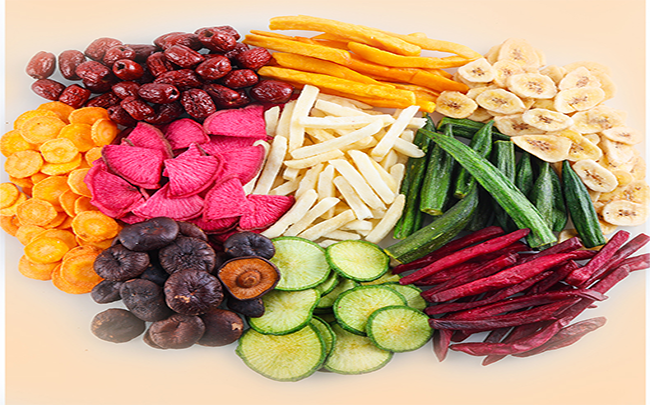
Freeze-dried Fruits and Vegetable Chips are a healthier and more nutritious alternative to conventionally produced snacks, which go through a high temperature process such as baking or frying. Compared to other conventional methods of drying such as hot air drying, freeze-dried products has better nutrient retention.
冻干果蔬脆片是一种更健康、更营养的替代品,可以替代传统的零食,因为传统零食需要经过烘烤或油炸等高温工艺。与热风干燥等传统干燥方法相比,冻干产品能够更好地保留营养成分。
BENEFITS OF FREEZE-DRYING TECHNOLOGY 冻干技术的优势
Low Temperature Processing 低温加工
Freeze drying is a low temperature dehydration process1 that involves freezing the product and lowering pressure, thereby removing the ice by sublimation.2 This is in contrast to dehydration by most conventional methods that evaporate water using heat.3 Because of the low temperature used in processing1, the rehydrated product retains many of its original qualities.
冷冻干燥是一种低温脱水过程,包括冷冻产品并降低压力,从而通过升华除去冰。这与大多数利用热量蒸发水分的传统脱水方法不同。由于加工过程中采用的低温,复水后的产品保留了许多原有的品质。
Improved nutrient retention 提高营养保留率
Compared to air drying, freeze drying improved retention of anthocyanins, phenolics, and antioxidant activity during processing of regular versus organic blueberries and raspberries, and in some cases it even increased the concentration of phytochemicals.4 Freeze drying also preserved total phenolics in marionberries, strawberries, and corn better than air drying.5 Freeze-drying is the best drying method to keep the nutritional value, antioxidant activity and sensory properties of fruits.6
References:
1. Ratti, Cristina (2008-11-21). Advances in Food Dehydration. CRC Press. pp. 209–235. ISBN 9781420052534.
2. Fellows, P. (Peter) (2017). "Freeze drying and freeze concentration". Food processing technology : principles and practice (4th ed.). Kent: Woodhead Publishing/Elsevier Science. pp. 929–940. ISBN 978-0081005231. OCLC 960758611.
3. Prosapio, Valentina; Norton, Ian; De Marco, Iolanda (2017-12-01). "Optimization of freeze-drying using a Life Cycle Assessment approach: Strawberries' case study" (PDF). Journal of Cleaner Production. 168: 1171–1179. doi:10.1016/j.jclepro.2017.09.125. ISSN 0959-6526.
4. Sablani, S. S., Andrews, P. K., Davies, N. M., Walters, T., Saez, H., & Bastarrachea, L. (2011). Effects of Air and Freeze Drying on Phytochemical Content of Conventional and Organic Berries. Drying Technology, 29(2), 205–216. https://doi.org/10.1080/07373937.2010.483047
5. Asami, D.K.; Hong, Y.-J.; Barrett, D.M.; Mitchell, A.E. Comparison of the Total Phenolic and Ascorbic Acid Content of Freeze-Dried and Air-Dried Marionberry, Strawberry, and Corn Grown Using Conventional, Organic, and Sustainable Agricultural Practices. J. Agric. Food Chem. 2003, 51, 1237–1241.
6. Orak H, Aktas T, Yagar H, İsbilir SS, Ekinci N, Sahin FH. Effects of hot air and freeze drying methods on antioxidant activity, colour and some nutritional characteristics of strawberry tree (Arbutus unedo L) fruit. Food Science and Technology International. 2012;18(4):391-402. doi:10.1177/1082013211428213


